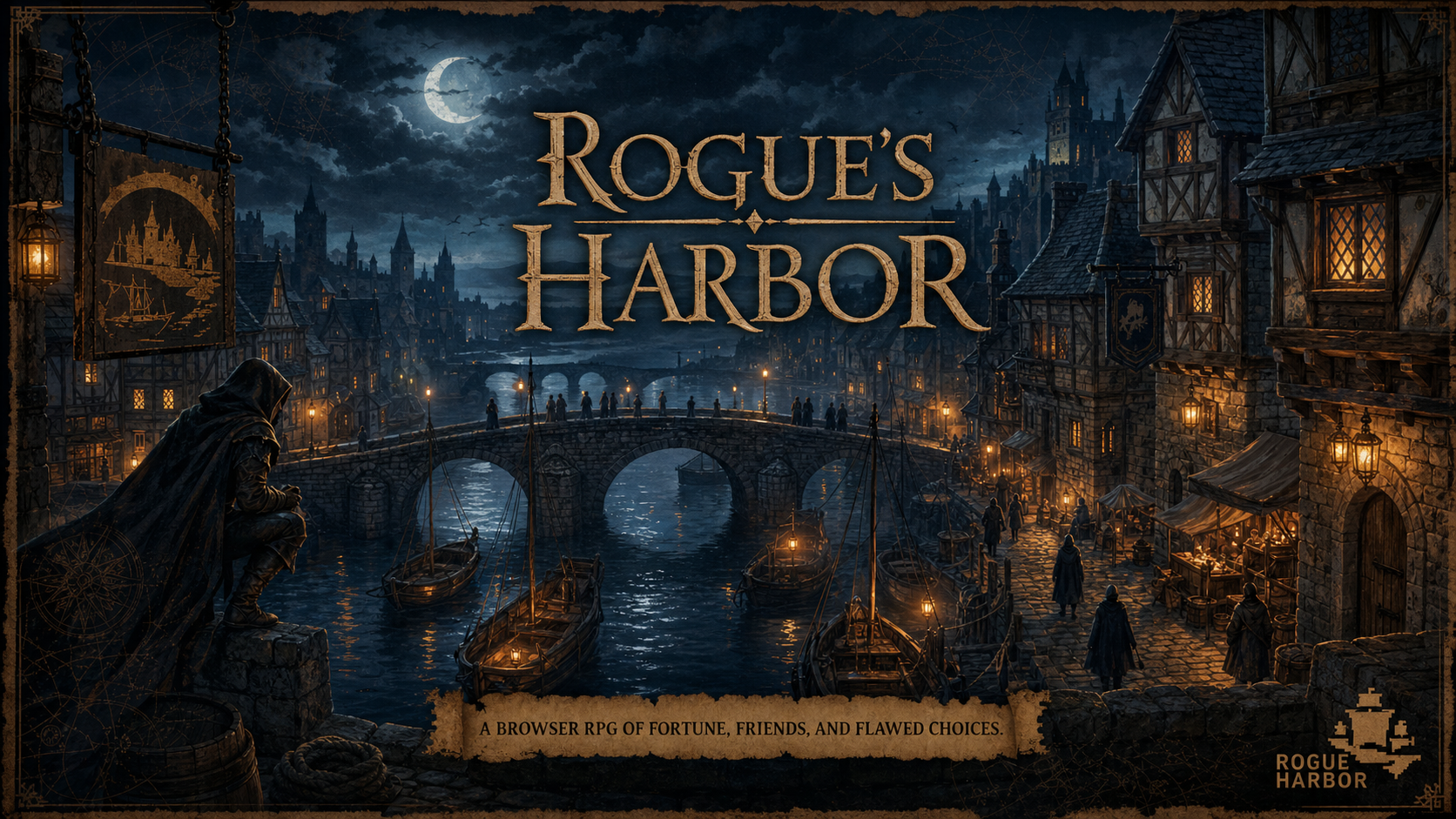
Rogue's Harbor is now live from Clovis Star as a browser-based fantasy role-playing game: a modern harbor world built from old game memories, early online culture, and the enduring appeal of mapped worlds.
Play Rogue's Harbor on Clovis Star
Clovis Star has always been interested in texts, traditions, fragments, games, and inherited worlds. A game can be a kind of text. A map can be a kind of manuscript. A tavern rumor, a route between cities, a ledger entry, a character inventory, or a player-built house can become part of a living archive of choices.
That is the spirit behind Rogue's Harbor.
The project owes a visible debt to Thieves' Guild, the BBS door game created by Paul Witte and Herb Flower under Mythyn Software. The Break Into Chat interview with Paul and Herb records the game's Utah/Orem background, its Atari ST visual client, its painted map, its city design, quests, NPCs, art, and the sense that a small creative team could build a meaningful multiplayer world with the tools available at the time. Read the interview here.
That history matters because Rogue's Harbor is not merely imitating old graphics. It is drawing from the culture that produced them: local computer communities, bulletin board systems, hand-built fantasy settings, and social play before the modern platform era.
There is also a personal memory at the heart of it. Paul Witte's BBS Dark Fortress was a huge part of Ryan Thompson's childhood, and the LAN parties in Orem with other gamers, experienced between roughly ages 13 and 15, became a rite of passage. Those rooms were not just about computers. They were about belonging, curiosity, competition, and the first realization that games could create communities.
Another thread comes from Ultima Online, played with Ryan's brother Brad over years of shared adventure. Those years of bonding became Happy Moments: proof that a virtual world can become part of a family story when it gives people a place to build, trade, risk, explore, and remember together.
Rogue's Harbor blends those influences into a new browser game. It includes towns, shops, taverns, NPCs, quests, map travel, inventory, banking, player profiles, stats, achievements, leaderboards, player economy systems, and the framework for land, houses, stores, buying, selling, and trading.
For the Clovis Star audience, the interesting part is not only that Rogue's Harbor is playable. It is that the game belongs to the same broad human pattern as historical board games, ancient route maps, religious libraries, marginal notes, and inherited stories: people create symbolic worlds, then return to them to test memory, judgment, risk, loyalty, and imagination.
Rogue's Harbor is a new game, but it carries an older question: what happens when a map becomes a social place?